
Cognitive Sovereignty in the Age of Artificial Intelligence
In the twilight of human intellectual sovereignty, we stand witness to a curious paradox. The very instruments we have fashioned to amplify our cognitive powers now threaten to atrophy the muscles of thought that gave them birth. Large Language Models, those glittering prophets of efficiency, whisper promises of liberation from intellectual labour whilst secretly binding us in chains of our own making. The recent revelations from OpenAI’s comprehensive study of user behaviour illuminate not a pathway to enlightenment but a descent into what might be called the commodification of consciousness itself.
The statistics tell a story that should give us pause. Non-work related messages have surged to 73% in June 2025 from 53% a year ago, revealing how these digital oracles have colonised not merely our professional endeavours but the intimate corners of daily existence. More troubling still, the user base is dominated by young people, with nearly half of the conversations studied coming from people aged 18 to 25, that crucial demographic whose intellectual architecture remains under construction, now choosing to outsource the very scaffolding of their cognitive development. Consider the fundamental deception at the heart of this technological seduction. The LLM presents itself as a benevolent servant, transforming fragmentary thoughts into polished prose, converting intellectual stammering into eloquent exposition. Within minutes, what might have taken hours of careful thought emerges fully formed, like Athena from the head of Zeus. Yet this mythological comparison reveals the illusion: Athena sprang from divine consciousness, whilst our artificial creations spring from statistical patterns, devoid of genuine understanding.
The act of reading, that ancient dialogue between mind and text, exemplifies what we stand to lose. When we engage with a book, we do not merely decode symbols on a page. We enter into communion with another consciousness, wrestling with ideas that resist easy comprehension, allowing ourselves to be transformed through intellectual struggle. The book becomes not a repository of facts to be extracted but a catalyst for metamorphosis. Each page turned represents a small victory over ignorance, each chapter completed a step in the journey toward wisdom.
The LLM summary, no matter how comprehensive, offers us the destination without the journey, yet in the realm of knowledge, the journey constitutes the destination itself. Over 55% of ChatGPT prompts fell into either learning or productivity-related tasks, with users frequently seeking shortcuts to understanding. This statistic reveals our collective willingness to trade genuine comprehension for its superficial appearance, to mistake the map for the territory it represents.Recent scientific investigations have unveiled the biological consequences of our Faustian bargain. Researchers used an EEG to record writers’ brain activity across 32 regions, and found that ChatGPT users had the lowest brain engagement and “consistently underperformed at neural, linguistic, and behavioral levels”. This finding transcends mere academic concern; it represents empirical evidence that our tools are literally diminishing our capacity for thought.
The implications ripple outward like waves from a stone dropped in still water. Each time we delegate our thinking to machines, neural pathways that would have been strengthened through use instead wither through neglect. The brain, that most plastic of organs, adapts to the demands we place upon it. When we cease to demand deep thought, concentrated attention, and sustained intellectual effort, we reshape ourselves into creatures less capable of these very activities.
Universities, those ancient citadels of learning, now face an existential crisis. The essay, that time-honoured crucible for developing critical thought, loses its power when students submit machine-generated simulacra instead of their own intellectual labour. The professor who reads these artificial productions encounters not the struggling consciousness of a developing mind but the smooth, soulless output of pattern recognition. The grades assigned become meaningless tokens in an elaborate charade where everyone pretends that learning has occurred whilst knowing, at some level, that it has not.
The modern workplace reveals another dimension of this tragedy. About 56% of work-related messages are classified as Doing, and nearly three-quarters of those are Writing tasks. Writing, that fundamental medium through which knowledge workers demonstrate their value, increasingly becomes the province of machines rather than minds. The irony cuts deep: in our quest to become more productive, we render ourselves progressively more redundant.
The senior programmer who once mentored juniors through code review now generates initial drafts through artificial intelligence. The experienced journalist who might have guided a cub reporter through the intricacies of investigative work instead prompts a machine for first drafts. The research supervisor who would have worked alongside graduate students in literature review now delegates this foundational work to algorithms. In each case, efficiency gains in the present create capability deficits in the future.This vanishing of apprenticeship represents more than economic displacement; it signals the breakdown of knowledge transmission itself. For centuries, expertise has passed from master to student through proximity, observation, and gradual assumption of responsibility. The junior lawyer who drafts briefs under supervision, the resident physician who performs procedures under watchful eyes, the young craftsperson who learns through repetition and correction: all represent links in an unbroken chain of knowledge transfer stretching back through generations.
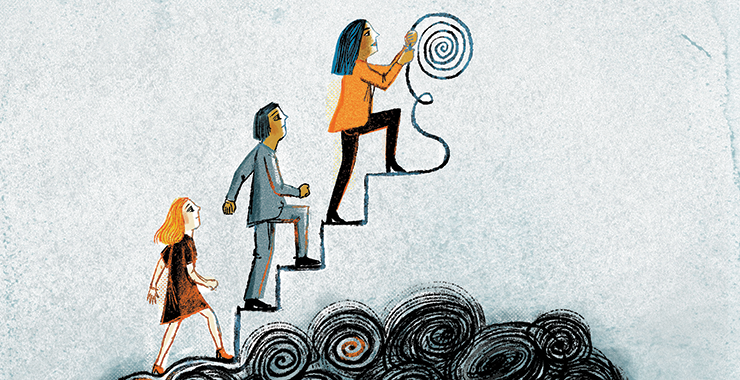
When we sever these links, we do not merely eliminate jobs; we destroy the very mechanism through which human expertise perpetuates itself. The ladder of professional development, painstakingly constructed over centuries, has had its lower rungs removed. Those at the top may continue to climb for a time, but when they eventually depart, who will possess the deep knowledge necessary to replace them?
Beyond the technical limitations of hallucination and factual error lies a more insidious threat: the amplification of our own intellectual limitations. The LLM, trained to please and programmed to align with user expectations, becomes a sophisticated mirror reflecting our biases back to us with enhanced clarity and apparent authority. Whatever beliefs we bring to the interaction, the machine will find ways to elaborate, support, and validate them.
Practical Guidance has remained constant at roughly 29% of overall usage, whilst Writing has declined from 36% to 24%, and Seeking Information has grown from 14% to 24%. This shift toward information-seeking becomes particularly concerning when we recognise that the information sought often serves not to challenge but to confirm existing beliefs. The conspiracy theorist finds evidence for plots; the ideologue discovers support for dogma; the prejudiced person encounters validation for bias.This represents an evolution beyond the echo chambers of social media. Where once we sought validation from like-minded human communities, we now receive it from machines that never tire, never challenge, never force us to defend our positions against rigorous opposition. The algorithm becomes our most agreeable companion, always ready to tell us how right we are, how clever our insights, how justified our prejudices.The traditional newspaper, for all its limitations, served as a corrective to this tendency. The physical act of turning pages meant encountering ideas outside our comfort zones, stumbling upon articles we would not have chosen, being forced to confront perspectives that challenged our assumptions. The editor’s judgment, however flawed, provided a curated window onto a shared reality. Now, each of us risks inhabiting a bespoke reality, tailored to our preferences and prejudices by machines that know only how to please.
The OpenAI data reveals a troubling acceleration in our dependence. People who signed up for ChatGPT in the 3rd and 4th quarters of 2024 are now sending nearly twice as many messages per day as they did less than a year ago. This doubling of usage suggests not satisfied users who have found a useful tool but addicts requiring ever-larger doses to achieve the same effect. Each interaction that saves time in the moment accumulates into a profound deficit of capability over time.
Consider what this dependency truly means. The student who cannot write without artificial assistance, the professional who cannot think without algorithmic support, the researcher who cannot synthesise without mechanical aid: all have traded temporary convenience for permanent incapacity. They have become intellectual invalids, dependent on prosthetic thinking to navigate a world that increasingly demands genuine human insight.
The LLM reflects not the pinnacle of human achievement but the average of digital discourse. It cannot distinguish between the profound and the mundane, the true and the merely popular, the wise and the widely repeated. Topics well-represented in online content yield plausible outputs; those requiring deep expertise or cultural nuance produce shallow simulacra. The machine that promises universal knowledge instead perpetuates and amplifies existing inequalities in information quality and availability. The path forward requires neither Luddite rejection nor uncritical embrace but something far more difficult: the conscious cultivation of those capacities that remain uniquely human. We must develop what might be termed intellectual sovereignty, a fierce independence of mind that uses tools without being used by them. This means recognising that every prompt typed, every task delegated, every thought outsourced represents a choice between developing our own capabilities and diminishing them.
The experienced professional who employs artificial intelligence whilst maintaining critical distance offers a model for appropriate use. They understand that the machine provides raw material, not finished products; suggestions, not solutions; starting points, not destinations. They bring to the interaction deep knowledge that allows them to evaluate, correct, and improve upon what the algorithm produces. Most crucially, they never forget that the value they provide emerges not from their ability to prompt machines but from the irreplaceable human judgment they bring to the task.
We must resist the siren song of effortless achievement. The difficult work of reading complete texts, of struggling with complex ideas, of producing original thought cannot be delegated without losing something essential to our humanity. Each book we read rather than summarise, each essay we write rather than generate, each problem we solve through our own cognitive effort represents an act of resistance against the commodification of consciousness. The crisis before us demands that we defend those practices and institutions that cultivate human intelligence. We must preserve apprenticeships, protect spaces for deep reading and contemplation, and celebrate the slow development of genuine expertise over the quick fix of artificial generation. We must teach our children not how to prompt machines but how to think for themselves, not how to extract information but how to create knowledge, not how to appear intelligent but how to become wise.
In this age of artificial intelligence, our task becomes the preservation and cultivation of natural intelligence. The young people who constitute the primary user base of these tools, those whose cognitive architecture remains under construction, require our particular attention. They must be shown that the struggle with ideas, far from being an obstacle to be circumvented, constitutes the very process through which minds develop strength and subtlety.
The data should serve as clarion call, not celebration. When three-quarters of usage involves personal rather than professional matters, when neural activity demonstrably diminishes with use, when dependency doubles within months, we face not technological progress but intellectual regression masquerading as advancement. The future belongs not to those who can most cleverly prompt machines but to those who preserve and develop the irreplaceable capacities of human consciousness.
In the end, we must choose between two futures: one in which we become increasingly dependent appendages to our mechanical creations, atrophying into intellectual obsolescence; or one in which we maintain our cognitive sovereignty, using tools whilst refusing to be diminished by them. The choice we make will determine not merely our economic prospects or professional success but the very nature of human consciousness in the centuries to come. The machines will continue to improve; the question remains whether we will choose to improve alongside them or allow ourselves to decay in their shadow. Our humanity itself depends upon our willingness to do the work that only humans can do: to think deeply, to struggle productively, to learn authentically, and through that process, to remain irreplaceably, irrepressibly human.