
The New Human Contract, Navigating the Dawn of the AI Co-Worker!
A decade is a curious measure of time. It is long enough for a child to be born and learn to speak in full sentences, yet short enough that the world it describes still feels like yesterday. The decade from 2015 to 2025 will be remembered differently. It was the period when a technology that had simmered for half a century finally boiled over, spilling out of research labs and into the fabric of our lives. This was the decade artificial intelligence stopped being a futuristic hypothetical and became a present, potent reality. It began with a machine mastering a game of profound human intuition and ended with it collaborating on the very definition of human work. This is the story of that arc, a chronicle of how we built a new kind of mind and are now learning to live alongside it.
The story of modern AI does not begin with a single invention but with a quiet convergence. Around 2015, three forces met: the raw computational power of graphics processing units became widely accessible, vast oceans of digital data became available for training, and a new generation of neural network architectures grew mature enough to learn from it all. That year, a breakthrough paper on Residual Networks, or ResNet, showed how to build “very deep” networks with over a hundred layers without their performance degrading.This innovation shattered previous limitations in computer vision, allowing machines to perceive and categorize the visual world with startling accuracy.
This new power needed a stage. It found one in March 2016, in Seoul, South Korea. There, DeepMind’s AlphaGo, a program built on deep reinforcement learning, faced Lee Sedol, the world champion of the ancient board game Go. Go, with its astronomical number of possible board positions, was long considered a bastion of human intuition, a grand challenge many experts believed was a decade from being solved by a machine. AlphaGo’s decisive victory was a profound shock, a “Sputnik moment” for the 21st century that announced the arrival of a new kind of strategic intelligence. The true revolution, however, was not that the machine won, but how it learned. The initial AlphaGo was trained on countless human games. Its successor, AlphaGo Zero, was taught nothing but the rules. It learned by playing against itself, and within days, it surpassed the version that defeated Lee Sedol, discovering novel strategies that were alien to centuries of human play. This was a critical leap from imitation to genuine, emergent knowledge. The principle was generalized with AlphaZero, which mastered Go, chess, and shogi using the same algorithm, and culminated in MuZero, a system that learned to master games without even being told the rules. It was building its own internal model of reality from scratch.
While machines were mastering the logic of games, a parallel revolution was brewing in the realm of language. For years, natural language processing had been dominated by recurrent neural networks, which processed text sequentially, word by word. This was a fundamental bottleneck, making it difficult to grasp the context of long sentences and preventing the massive parallel processing needed for training on internet scale data.
In 2017, a paper from Google researchers titled “Attention Is All You Need” dismantled this paradigm. It introduced the Transformer architecture, which used a mechanism called “self-attention” to weigh the importance of all words in a sentence simultaneously, regardless of their position. This allowed the model to build a deeply contextual understanding of language and, crucially, enabled training to be massively parallelized. The Transformer was the architectural key that unlocked the modern era of AI.
What followed was a new training philosophy. Researchers began building enormous “foundation models” on the Transformer architecture. Two main branches emerged. Google’s BERT, released in 2018, used the Transformer’s “encoder” to create a deep, bidirectional understanding of text, shattering records on tasks that required comprehension. In parallel, OpenAI’s GPT series used the “decoder” to become exceptionally fluent at generating text. This culminated in 2020 with GPT-3, a model of unprecedented scale. It demonstrated a startling, emergent ability called “few-shot learning,” performing tasks it was never explicitly trained on simply by being shown a few examples in a prompt. The age of large language models had begun.
The public release of ChatGPT in late 2022 was the catalyst that turned this technological momentum into a societal phenomenon. The landscape of 2025 is the result of that explosion, an “AI Big Bang” whose light is still reaching us. The frontier is dominated by a handful of major players like OpenAI, Google, Anthropic, and Meta, each pushing the boundaries of what is possible. This concentration of power has been met by a vibrant open source movement, creating a dynamic ecosystem where cutting edge proprietary models coexist with smaller, more adaptable open alternatives.
The state of the art has moved decisively beyond text. Today’s leading models are multimodal, capable of understanding and generating information across text, images, audio, and video in a seamless flow. Models like GPT-4o and Gemini can look at a picture, listen to a spoken question about it, and generate a detailed textual answer. The recent arrival of high fidelity text to video models like Sora and Veo signals the next frontier in this sensory fusion, promising to reshape media and entertainment.
Even more transformative is the shift from passive generation to active agency. AI is evolving from a tool that answers questions into an agent that accomplishes goals. By giving models access to tools like web browsers, code interpreters, and software APIs, developers are empowering them to execute complex, multi step tasks. An AI agent can now be given an objective, formulate a plan, use its tools to gather information or perform actions, and adapt its approach until the goal is complete. This is the dawn of the AI collaborator, a digital partner that can manage workflows, debug code, and accelerate scientific discovery in fields from drug design to medical diagnostics.
Yet for all their power, these systems are not minds in the human sense. They are sophisticated pattern matching engines, and their intelligence has a “jagged frontier.” They can outperform experts on specific tasks but fail at problems requiring basic common sense. Their limitations are becoming clearer. They are prone to “hallucinations,” generating plausible but false information. Their reasoning is often a fragile imitation of patterns seen in their training data, not a deep, causal understanding of the world. And because they are trained on the vast, unfiltered text of the internet, they can inherit and amplify human biases related to race, gender, and culture. The illusion of thought is powerful, but it remains an illusion.
This new form of intelligence is now being woven into the professions built on human thought. The “knowledge worker,” a term coined by Peter Drucker to describe those who think for a living, is at the center of this transformation. Their primary capital is expertise, applied to solve non routine problems. For decades, their value has been defined by their ability to acquire, synthesize, and apply specialized information. Now, a machine can do much of that in an instant. The question is no longer if AI will change their work, but how it will redefine their purpose.
The impact is best understood not as a binary choice between human and machine, but as a spectrum from automation to augmentation. Automation is the complete delegation of tasks to AI. A significant portion of knowledge work consists of complex but repeatable activities: gathering data, summarizing documents, drafting standard emails, and writing boilerplate code. These are the chores of the cognitive world, the intellectual equivalent of manual labor. AI is proving exceptionally adept at these tasks, freeing professionals from a great deal of cognitive drudgery to focus on higher value work.
This liberation, however, comes with a hidden cost. These routine tasks have long served as the training ground for junior professionals. An entry level analyst learns the fundamentals of finance by manually building models. A junior lawyer develops legal acumen by conducting painstaking document review. A novice coder masters their craft by writing and debugging simple functions. AI now automates much of this “codified knowledge,” the explicit, rule-based information that can be learned from a textbook. This creates a looming crisis in professional development. If the first rungs of the career ladder are automated away, how will the next generation of experts acquire the deep, intuitive “tacit knowledge” that only comes from experience? We may be creating a generation of pilots who have only ever flown on autopilot.
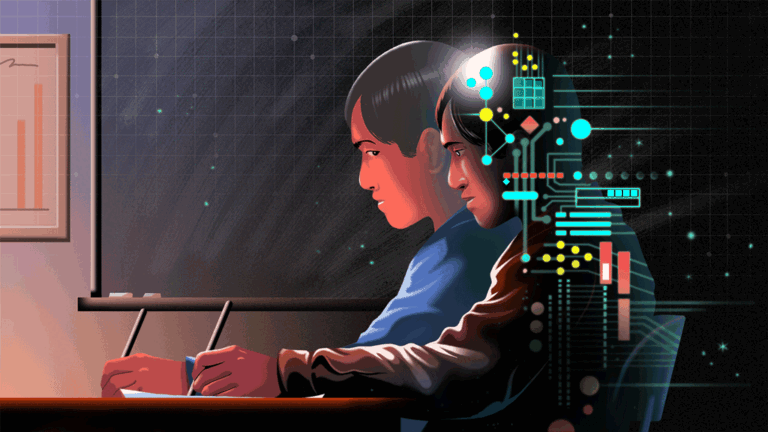
More profound, and more personal, is the impact of augmentation. This is where AI acts as a collaborative partner, a “copilot” that enhances human capabilities. In this “centaur” model, the division of labor is clear. The AI handles scale, speed, and pattern recognition; the human provides strategic direction, creative insight, contextual understanding, and ethical judgment. This is not a simple tool; it is a new kind of professional relationship.
Consider the lawyer. Before, their day was consumed by research, sifting through case law for relevant precedents. Now, an AI can perform that search in minutes, presenting a synthesized summary of key arguments. The lawyer’s role shifts from excavator to architect. They are no longer digging for information but using the AI’s findings to construct a novel legal strategy, to anticipate the opposition’s moves, and to counsel their client with a depth of data-driven insight that was previously impossible.
Or the software developer. The AI copilot generates lines of code, completes functions, and suggests bug fixes. The developer is no longer a mere typist of syntax. They become a systems thinker, a creative director for the code. Their work is elevated to a higher level of abstraction, focused on designing the overall architecture, validating the AI’s logic for security flaws and inefficiencies, and orchestrating the complex interplay of different software components. Their value is no longer in what they can write, but in what they can envision.
This partnership transforms the very nature of expertise. The knowledge worker of the near future will not be the person with the most facts memorized. They will be the person who asks the best questions. Their core competency will be the art of the prompt, the ability to translate a complex, ambiguous human goal into a precise instruction that guides the AI toward a powerful and relevant output. This is a new form of literacy, a dialogue between human intuition and machine intelligence.
This shift precipitates a radical reordering of valuable skills. As AI commoditizes the application of existing knowledge, the premium shifts to abilities that are uniquely human and complementary to AI. These are not narrow technical competencies, which can become obsolete with the next software update. They are durable cognitive and interpersonal capabilities.
First is judgment, which in the age of AI becomes the art of the intelligent “no.” AI models generate answers with unearned confidence. The most valuable professional will be the one with the wisdom to question the algorithm, to interrogate its assumptions, and to recognize when its statistically plausible answer is practically or ethically wrong. Like a guide dog trained to disobey a command that would lead its owner into traffic, the future knowledge worker must have the courage to override the machine.
Second is insight, the ability to connect the dots across unrelated domains. AI excels at finding patterns within the data it was trained on. It is terrible at making creative leaps between disconnected ideas. It cannot connect demographic shifts in one continent, changing consumer tastes in another, and supply chain disruptions in a third to foresee a new market opportunity. That remains the province of human creativity, of the mind that thinks laterally and sees the patterns that the data does not yet show.
Third is social intelligence. Empathy, persuasion, mentorship, and collaboration are the currencies of the new economy. As AI handles more of the solitary, analytical work, the human-to-human skills become paramount. The ability to lead a team through uncertainty, to build a relationship of trust with a client, or to negotiate a complex deal will define the most essential roles. These are the tasks that cannot be reduced to an algorithm.
Finally, there is integrity. In a world of automated decision making, trust becomes the ultimate competitive advantage. An algorithm programmed to maximize revenue will automatically raise prices during a natural disaster. It takes a human to decide that this is wrong, to balance profit with principle. The leaders and professionals who thrive will be those who ask second-order questions: not just “Is this effective?” but “Is this right?” Not just “Is this legal?” but “Is this fair?”
The story of AI is now our story. The path forward diverges into two distinct futures. One is a vision of shared prosperity, where AI-driven productivity gains create new economic abundance, liberating people to pursue more creative and meaningful work. The other is a cautionary tale of exacerbated inequality, where the benefits of this revolution are captured by a select few, deepening social divides and threatening cohesion.
The decade from 2015 to 2025 was about building the machine. The decade to come will be about the choices we make in how we use it. The outcome is not a technological inevitability. It will be determined by our foresight in redesigning education, our wisdom in crafting policy, and our commitment as leaders and individuals to a human-centered vision of progress. The arc of this technology is still being written. We are the ones holding the pen.