A Nation That Argues From the Maidan to the Meme!
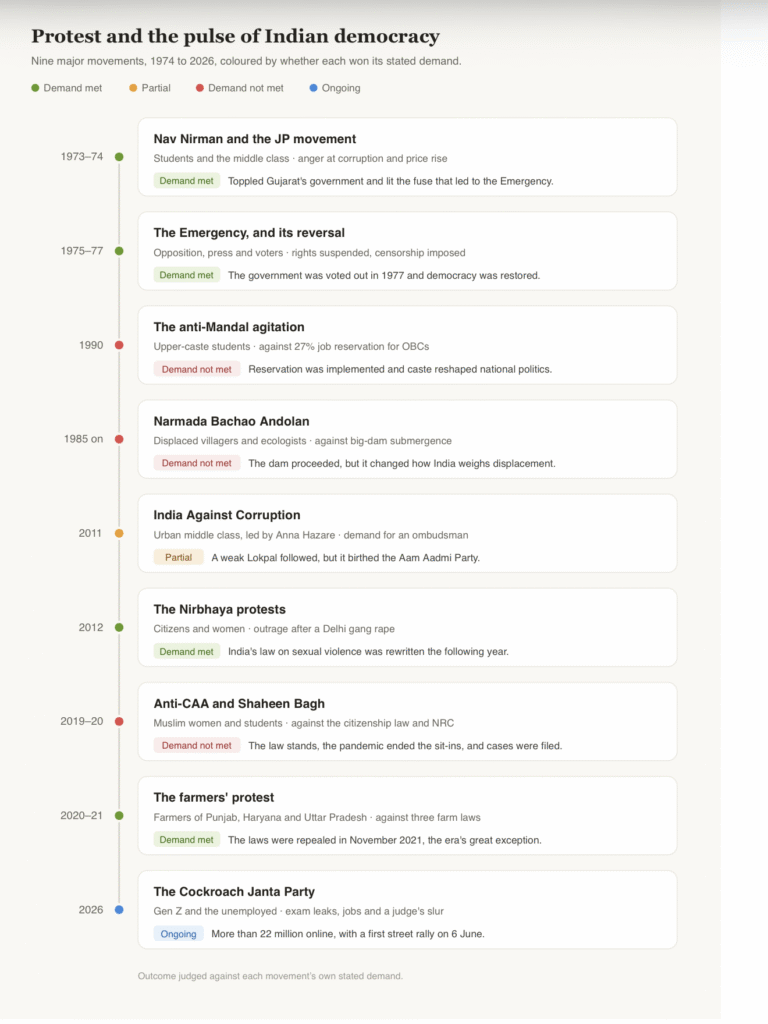
A protest is the cheapest and most honest instrument a society owns for measuring its own condition. Elections happen on a fixed schedule and can be managed; the street does not wait for permission. Who marches, over what grievance, against whom, and with what consequence; these tell you more about the real distribution of power than any manifesto. Read in sequence, India’s protests since 1947 form a kind of clinical chart of the Republic, the rising and falling temperature of a democracy that has never stopped arguing with itself. The cockroaches are the latest reading, and the chart that leads to them is worth following carefully.
India was born from agitation, so dissent was never an external threat to the state; it was the state’s own founding method turned inward. The generation that wrote the Constitution had spent its adult life in jail for civil disobedience. They drafted a document that guaranteed the right to assemble and to speak, and then they had to govern people who took those guarantees literally. The first decades saw language agitations that redrew the internal map, peasant mobilisations, and the slow politicisation of caste. The system absorbed most of it. The map was redrawn along linguistic lines after a man named Potti Sriramulu fasted to death in 1952, an act that forced the creation of a Telugu-speaking state and then, by 1956, a wholesale recasting of the country’s internal borders. The lesson of those years was that pressure from below could move the state without breaking it.
That confidence met its hardest test in the early 1970s. Gujarat erupted first, in the Nav Nirman Andolan of 1973 and 1974, when students furious over hostel food prices and visible corruption brought down a sitting chief minister. The energy travelled east to Bihar, where Jayaprakash Narayan, a freedom fighter who had withdrawn from electoral politics, returned to lead what he called Total Revolution. He asked students to give a year to cleaning the system. The movement was diffuse and idealistic, yet it frightened a government that had grown used to dominance.
The reckoning came on 25 June 1975, when Indira Gandhi declared a state of Emergency. The press was censored, opposition leaders were jailed, and elections were suspended. For twenty-one months the Republic suspended its own central promise. This was the single gravest threat Indian democracy has faced, and what makes the episode instructive is how it ended. When elections were finally called in 1977, the electorate threw the government out. The same machinery that had been used to silence dissent was undone by a vote. Indian democracy survived its near-death experience because enough institutions, and enough ordinary voters, refused to ratify the suspension.
The Emergency left a permanent watermark on the national conscience. Every subsequent attempt to muffle dissent has been measured, by critics at least, against that memory. It established a working principle, that the gap between holding elections and respecting freedom is the space where democracies quietly die, and that India had walked to the edge of that gap and stepped back.
The decades that followed broadened the cast of who protested and over what. In 1990, the Mandal moment split the country open along caste. When the V. P. Singh government moved to implement the Mandal Commission’s recommendation reserving twenty-seven per cent of central government jobs for Other Backward Classes, upper-caste students poured into the streets, and some set themselves alight. The episode forced an uncomfortable truth into the open, that the formal equality of the Constitution coexisted with a deeply unequal society, and that the fight over who gets which scarce opportunity would define Indian politics for a generation. The question of jobs and fairness, the same question now animating the cockroaches, was already burning thirty-six years ago.
Elsewhere, the Narmada Bachao Andolan, led from the mid-1980s by Medha Patkar, gave displacement and ecology a national voice. Villagers facing submergence by the Sardar Sarovar dam stood in rising water rather than leave. They mostly lost the engineering battle, yet they changed the moral vocabulary of development and forced courts and planners to weigh the human cost of large projects. Protest in these years was less about toppling a leader and more about contesting what progress should mean and who should pay for it.
For a long stretch, India’s salaried urban middle class watched protest from a distance, treating the street as someone else’s business. That changed in 2011. The India Against Corruption movement, fronted by the Gandhian activist Anna Hazare and organised by a sharp younger cadre that included Arvind Kejriwal, turned a demand for an anti-corruption ombudsman into a national spectacle. Hazare’s fast at Ramlila Maidan drew enormous crowds and round-the-clock television. The grievance was specific, a Jan Lokpal Bill, but the energy was generational and class-based, a newly prosperous India angry that graft was the tax it paid for everything.
The movement’s importance lies less in its stated goal, which was only partly achieved, than in what it produced. It birthed the Aam Aadmi Party, which captured Delhi and proved that street energy could be converted into electoral power. It normalised mass urban protest as a respectable middle-class act. The following winter, in December 2012, the gang rape and murder of a young woman on a Delhi bus brought tens of thousands into the cold to demand that the state treat women’s safety as a first-order obligation, and the law on sexual violence was rewritten the next year in response. Together this churn fed a broader anti-establishment mood that the Bharatiya Janata Party rode to a parliamentary majority in 2014. The template that emerged from these years, leaderless or thinly led, media-saturated, morally framed, is the direct ancestor of what is unfolding now.
Here the chart turns, and honesty requires care, because this is the most contested stretch of the story.
The independent measures point one way. The V-Dem Institute at the University of Gothenburg, which runs the largest global dataset on democracy, reclassified India from a democracy to an “electoral autocracy” around 2017 to 2020, and its 2025 report keeps India in that category while ranking it 100th of 179 countries on the Liberal Democracy Index. V-Dem attributes the slide to deteriorating freedom of expression, harassment of journalists, and pressure on civil society and the opposition, and dates the autocratisation to roughly 2014 onward. Freedom House cut India from “Free” to “Partly Free” in 2021 and has kept it there, its score sliding to 66 out of 100 in the 2024 report from 77 as recently as 2018, with a further fall recorded in 2025. Reporters Without Borders ranks India 157th of 180 countries in its 2026 press-freedom index, within the band it labels “very serious”, after a brief lift to 151st in 2025. Read together, these are not the readings of a healthy system.
The protests of this period bear the same signature. The agitation against the Citizenship Amendment Act through the winter of 2019 and 2020 produced Shaheen Bagh, a sit-in led largely by Muslim women in Delhi who held a stretch of road for months. It ended only when the pandemic cleared the streets, and the surrounding period saw communal violence in the capital and a wave of criminal cases against organisers. The farmers’ protest of 2020 and 2021 was the era’s great exception. Farmers camped on Delhi’s borders through a brutal winter against three farm laws, hundreds reportedly died over the course of the movement, and in November 2021 the government repealed the laws outright. That repeal is the strongest recent evidence that the old principle still holds, that a disciplined, sustained, economically rooted movement can still bend the state.
The government and its supporters reject the indices with vigour, and their case deserves a fair hearing. They point out that India holds genuinely competitive elections with very high turnout, that the BJP lost its single-party majority in 2024 and now governs in coalition, that the Supreme Court has struck down the electoral bonds scheme and that the farm laws were withdrawn under pressure. They argue that opposition leaders campaign and win freely, and that Western indices smuggle in liberal assumptions that misread what they call India’s civilisational model of democracy. The foreign ministry has dismissed such reports as inaccurate and distorted, and told its critics that India does not need their sermons.
Both things can be true at once. India remains a place where governments lose elections and courts occasionally rule against the executive, which closed autocracies never permit. It is also a place where the cost of dissent has risen, where sedition and counter-terror statutes are deployed against critics, where internet shutdowns are routine, and where the space between casting a vote and speaking freely has narrowed. The temperature chart does not show collapse. It shows a fever that the patient keeps insisting is good health.
Which brings the story to its present reading. On 15 May 2026, during a Supreme Court hearing, the Chief Justice of India, Surya Kant, remarked that there are youngsters “like cockroaches” who find no employment, drift into activism and social media, and attack everyone. He later said he had meant only those who fake credentials, but the words were already loose in the country. The next morning Dipke, a political communications strategist who once worked with the Aam Aadmi Party, posted a single line on X asking what would happen if all the cockroaches came together. Within days the Cockroach Janta Party had more Instagram followers than the BJP or the Congress, and by the time of the Jantar Mantar rally the count had crossed twenty-two million.
The trigger was an insult, but the fuel was structural. India’s youth unemployment is severe in a particular and cruel way; the people most likely to be jobless are the educated. The young account for roughly eighty-three per cent of all the country’s unemployed, and the jobless rate for graduates runs near twenty-nine per cent, far above the rate for those with little or no schooling. The share of unemployed young people who hold a secondary or higher qualification has almost doubled since 2000, reaching about sixty-six per cent by 2022 (ILO and Institute for Human Development, India Employment Report 2024). A degree, meant to be insurance, has become a liability. Into that frustration fell the NEET medical entrance examination, sat by more than 2.27 million aspirants on 3 May 2026 and cancelled nine days later after investigators found that a circulated guess paper overlapped with the real one. It was the second such collapse in three years. For a generation that had been told to study harder and wait its turn, the message landed as betrayal.
What makes the cockroaches genuinely new is the form. The movement has no leader in the old sense; its own slogan insists on members rather than leaders. It is native to the phone rather than the maidan, fluent in irony rather than slogans, and built around economic humiliation rather than ideology or caste. It treats self-mockery as armour, adopting the slur thrown at it and wearing the mask in public. This is the protest grammar of 2011 stripped of its earnestness and rebuilt for a generation that trusts almost no institution and laughs to keep from despairing. It also sits inside a regional pattern, because youth movements born online have already shaken governments in Sri Lanka, Bangladesh, and Nepal, and India’s young have noticed.
Whether it lasts is an open question. The X account was blocked within a week. The state met Saturday’s march with riot gear and steel barricades, a reminder that the cost of dissent remains real. Sceptics, including many in the ruling party, argue that online numbers rarely convert into durable organisation and that the whole thing will fade. They may be right. The farmers’ victory came from people who could hold ground for a year, and a meme cannot hold ground. But the grievance the cockroaches name will not fade, because the joblessness is not a mood. It is arithmetic.
The history above offers a usable lesson, that India’s democracy has repaired itself when ordinary people did unglamorous things consistently, and has frayed when they treated citizenship as a once-in-five-years errand. The work that matters is rarely the work that trends.
Vote, and vote informed, in the elections that decide your daily life rather than only the ones that fill the news. Municipal and panchayat bodies shape your water, your roads, and your child’s school, and they are won by tiny margins and lost to apathy. Learn who your local representatives are and make them account for what they spend.
Use the instruments the Republic already gives you. The Right to Information Act is the closest thing an ordinary person has to a lever inside the machine, and it works when used. A single well-aimed RTI application has exposed more local corruption than a thousand angry posts. Treat it as a habit, not a last resort.
Pay for the journalism that holds power to account, because a press that survives on the goodwill of the powerful cannot check them. Independent reporting is expensive and it is dying for want of readers willing to fund it. Subscribe to one outlet you trust and you keep a watchdog fed.
Before you share, verify. A great deal of what now passes for political participation is the forwarding of falsehood, and a citizenry that cannot tell true from false is the easiest of all to govern badly. Slow down, check the source, and refuse to be the link in the chain that carries a lie.
When you do take to the street, stay lawful and stay disciplined, because the movements that won did so by outlasting provocation rather than answering it. The organisers at Jantar Mantar told their crowd to carry a book and a flag and to avoid confrontation with the police, which is precisely the instinct that turns a moment into a force.
And build, do not merely protest. The Emergency was reversed by an electorate, the farm laws by an organisation, and the abuses of the 1970s by institutions that held. Outrage is the spark; structure is the engine. Join something, fund something, run for something small. A democracy is not maintained by the people who shout loudest in a single season. It is maintained by the people who keep showing up after the cameras leave.
The cockroaches may or may not become a party. The deeper test is whether the millions cheering them online will do the patient, boring work of citizenship once the joke stops being funny. India has answered that test well before. The chart shows a country running a fever, and a fever is not the same as a corpse. What happens next depends, as it always has, less on the man with the megaphone than on the ordinary people deciding whether to keep arguing with their own state.