जब जब मोदी डरता है, पुलिस को आगे करता है।
I am not a party worker. I am not an activist. I am a citizen, and on the evening of 20 July my heart broke watching my own country fire tear gas at its own children.

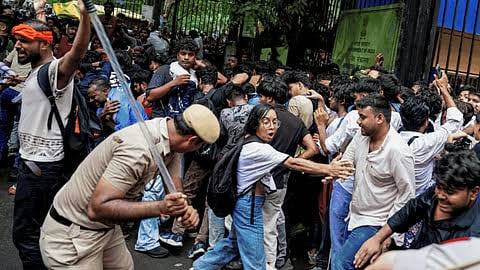
I have voted in every election since I came of age. I have stood in the long queues in the summer heat, pressed the button, held up the inked finger for the photograph, believed each time that this was the whole point of the thing we call a republic. That belief is what makes the footage from Delhi so hard to hold. On 20 July I watched young people who had come to the capital to ask for nothing more than a fair examination be met with lathis near Parliament Street, with tear gas shells drifting across Shastri Bhawan and Raisina Road, with vans and detentions and, in parts of the city, an internet connection quietly switched off so that fewer of us would see. I watched a country I love raise its hand against the very generation it is supposed to carry forward, and I felt something I have not felt about my own government in a long time. Not disagreement. Shame.
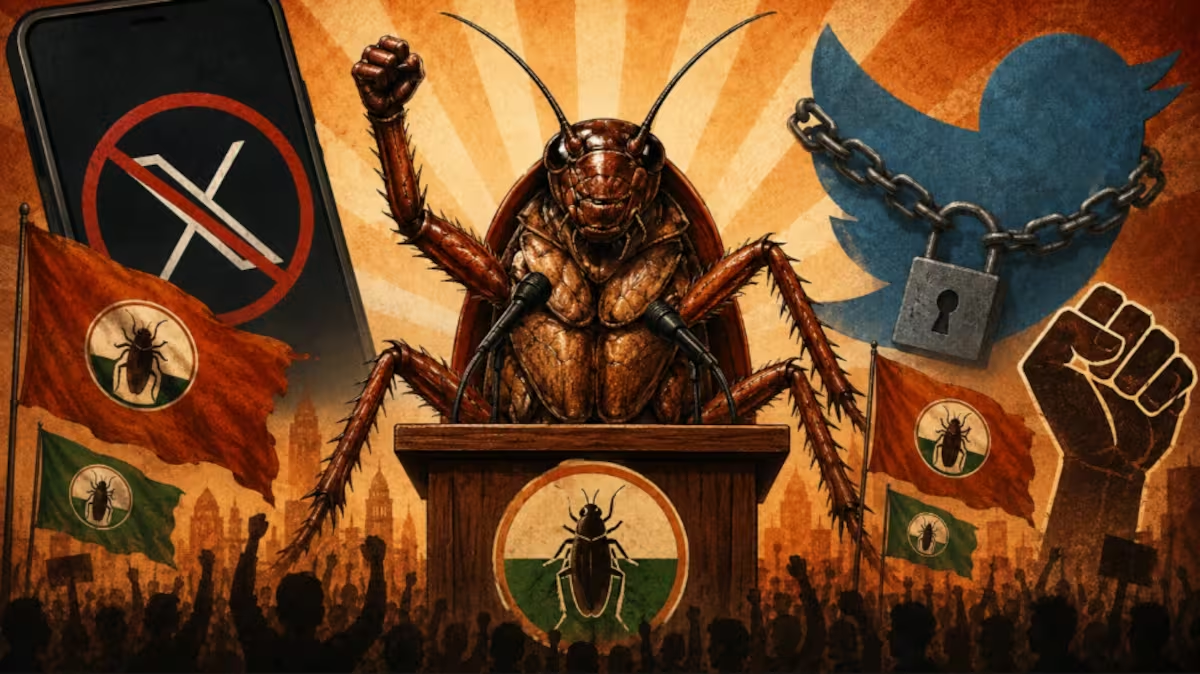
Let me set down what happened, because the record deserves to be kept plainly. For more than forty days a group of the young had been sitting at Jantar Mantar, since 6 June, under a banner absurd enough to be unforgettable. They called themselves the Cockroach Janta Party, wearing as a badge the very word a sitting judge had reached for. The Chief Justice of India, Surya Kant, had likened restless and unemployed young Indians to cockroaches; the young took the insult and made it their name. There is a terrible dignity in that. When those in power call you vermin, you can either shrink or you can march under the word until it shames them instead of you.
They chose to march. On 20 July they set out for Parliament in what they called the Sansad Chalo procession. The state’s answer arrived in gas and wood. The activist Sonam Wangchuk, who had been on hunger strike at the site, was removed by force and taken to hospital; the movement’s founder, Abhijeet Dipke, had himself been fasting before he broke it to lead the crowd. By the police’s own accounting the day left at least 118 personnel hurt and between fifteen and twenty government vehicles damaged, while hospital and police sources counted around sixty injured protesters, and Ram Manohar Lohia Hospital alone recorded sixty-five medico-legal cases by seven that evening. A sitting Member of Parliament, Dimple Yadav of the Samajwadi Party, was detained. So were roughly seventy others. The party has claimed that one of its members had his leg broken after being dragged by the Delhi Police.
I will not lie to you and paint the afternoon as wholly one-sided, because a citizen who only sees what flatters his argument is no better than the government he criticises. Reporting from the ground records that after hours of repeated tear-gassing the crowd broke, that stones were thrown, that police vehicles were smashed near Rajiv Chowk. Some constables were genuinely hurt, and I hold no brief for anyone who injured them. Yet I cannot escape the sequence. The children did not begin the day throwing stones. They began it asking to be heard, and the honest question every one of us should sit with is whether tear gas was ever the right reply to a nineteen-year-old holding a placard about her exam. A state that has confidence in its own conduct does not need to cut the internet to manage a crowd of students.
Strip away the noise and the demand underneath is almost heartbreaking in its reasonableness. NEET-UG 2026, the single medical entrance on which the future of the country’s aspiring doctors turns, was written on 3 May by more than 2.27 million young people. On 12 May it was cancelled, after investigators found that a guess paper circulating before the test overlapped with the real question paper. Beside it festered a second wound, the collapse of confidence in the Central Board of Secondary Education’s On-Screen Marking and revaluation, which left thousands of school-leavers waiting on results that would decide where, and whether, they could study at all. Opposition notices in Parliament this week put the reach of the alleged leak network at over twenty-two lakh candidates.
Think about who these people actually are. They are not insurgents. They are the seventeen and eighteen and nineteen-year-olds who did everything this system asked of them, who gave their adolescence to coaching classes and mock tests and the quiet terror of a single morning that would decide the rest of their lives, and who were then told that the morning itself had been sold. Their slogan through all of it has been four words, exam not scam. When a child asks the state for an honest examination and the state answers with a baton, the child has not failed the republic. The republic has failed the child.
Here is the thing I have come to understand, slowly and unwillingly. A democracy does not usually die in a single night of tanks and proclamations. Ours still has all its furniture. We still vote, Parliament still sits, the newspapers still print. The Swedish institute that has tracked the world’s democracies for decades, V-Dem, has since 2021 placed India in the category it calls electoral autocracy, a country that keeps the outward machinery of elections while the spirit that gave them meaning is hollowed from within. I used to bristle at that phrase. After 20 July I understand it as a description rather than an insult.
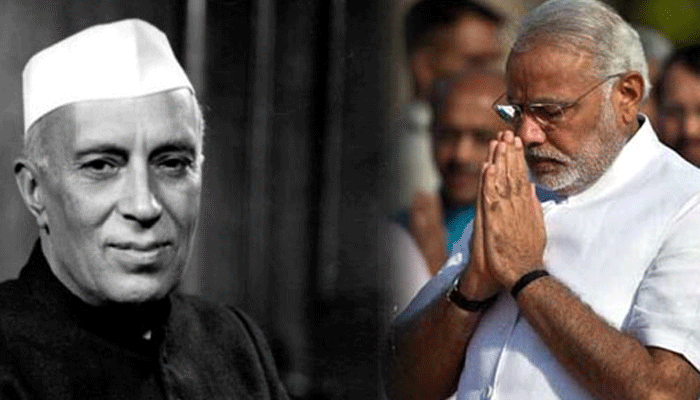
The tell of an elected autocracy is never the ballot. It is the reflex. It is what power does in the moment it is questioned. A confident government hears a chant outside its gates and sends someone out to talk. A frightened one sends out the police. That is the whole meaning of the sentence that has become this movement’s title, and it has become a title precisely because so many of us recognise it as true. Jab jab Modi darta hai, police ko aage karta hai. Whenever Modi is afraid, he pushes the police out in front of him. The fear is never named as fear. It is dressed as law and order, as the maintenance of dignity around Parliament, as the necessary firmness of a serious state. But strip the costume away and what stands underneath is a government that has grown allergic to the sound of its own young disagreeing with it.
And where, in all of this, was the man himself? This is the part that unsettles me most, because I remember a different Prime Minister. I remember the tireless voice, the one that speaks to us on the radio each month about everything from millets to yoga to the stress our children feel before their board exams, the orator who can fill a stadium and hold a rally spellbound for an hour. On the things that flatter him, that voice never tires. It is on the things that wound us that it goes strangely, reliably quiet. I have started to think of him, in these seasons, as a second person living inside the first. Maunendra Modi, the silent one.
Understand me precisely, because the fact matters. He did speak this week. On 21 July, at a meeting of his own NDA members and again as the monsoon session opened, he called the paper leak a grave sin, reminded the country that thirteen people had been arrested, that a re-examination had been held and its results declared on time, that nobody would be spared, that preventing leaks was a national responsibility rather than one state’s failure. He asked for logic, not chaos. It was a careful, self-exonerating speech about an examination. And as ThePrint’s own reporting noted, it contained no mention whatsoever of the protests, of the children gassed a day earlier in his capital, of the Member of Parliament dragged into a police van, of the boy whose leg was said to be broken. He broke his silence about the leak only to defend himself, and kept it, whole and undisturbed, about the batons.
This is the silence I want us to name, because it is not new. He said very little for weeks while Manipur burned, and found his voice only after a video of two women being paraded naked forced the country’s hand. He had no comfort to offer the champion women wrestlers of this nation when they sat on the pavement alleging abuse and were themselves dragged along the road by the same Delhi Police, within sight of the new Parliament he had just inaugurated. He was quiet through the long winter of the farmers at the city’s edge. He offered no reckoning in Parliament when the questions about the Adani Group grew loudest. He gave us a single strange sentence, that no one had intruded, while the country worried about Chinese soldiers in Ladakh, and then said little more. He was silent as the young burned buses over the Agnipath scheme, silent through much of the anguish over jobs that never came, and he has not once in more than a decade stood before a room of journalists and simply taken their unscripted questions.
A man who has so much to say about our exam stress has had almost nothing to say when the exams themselves were stolen and the children who protested the theft were beaten for it. That is not shyness. Over eleven years it becomes a method.
Around all this silence sits a minister who will not move. The single unbroken demand of this agitation, from the first day at Jantar Mantar to the gas of 20 July, has been the resignation of the Union Education Minister, Dharmendra Pradhan. This is the same minister who, taking charge for a second term amid the earlier NEET storm, assured the country there was no evidence of a paper leak and that allegations against the testing agency were unfounded. Two years on, an entrance has been cancelled for exactly the leak he waved away, a marking system has buckled, and the chair beneath him has not so much as wobbled. The opposition has pointed, fairly or not, to a longer ledger, to the paper leaks that have plagued state after state under this dispensation, to the ghost of Vyapam that still hangs over the movement’s memory. Whatever one makes of that ledger, the plain fact remains that no one at the top has been asked to carry the weight of what happened. The message a teenager receives from this is exact and corrosive. Her future is expendable. His portfolio is not.
Somewhere in the crowd on 20 July stood a father who had already lost the argument in the cruellest way a parent can. Riya Thapa, a NEET aspirant, had died by suicide. Her father came to Jantar Mantar and persuaded Dipke, weak from his own hunger strike, to break his fast and lead the march. The movement now counts twenty young lives it links to this examination collapse, a figure its leaders repeat and that the government has not seriously engaged; I offer it as their claim rather than a settled fact, and I find I cannot round it down in my heart even as I flag it in my prose. Dipke put the accusation in words that will outlive the tear gas, saying this government was not satisfied with taking the lives of twenty NEET students and was now baying for the blood of others. You may treat the number as contested. You cannot treat the grief as anything but real.
Weigh the two accounts the state has given us this week. On one side, the swift and precise arithmetic of 118 hurt personnel and twenty damaged vehicles, released within hours. On the other, no comparable urgency about the young whose lives the leak has upended, no resignation, no leader willing to stand before the nation and take the weight of it in his own voice. A government that can count its bruised vehicles to the decimal, yet cannot bring itself to count the cost to its children, has told us in the clearest possible terms where its tenderness lies.
I did not come to this conclusion easily, and I take no pleasure in it. But I have watched too carefully to pretend otherwise. A government that answers its examinees with gas, that detains a Member of Parliament alongside teenagers, that reaches for the internet’s off-switch to spare itself the embarrassment of being filmed, and whose Prime Minister can find his voice for the leak but not for the beating, has forfeited something a mandate cannot restore. It has lost the consent that is the only thing an election is really for. The republic is not being murdered in the dark. It is being quietly persuaded, one baton charge at a time, that this is simply how things are done now, that children who ask questions are a law-and-order problem, that the man at the top owes us his silence rather than his answers.
I do not believe that. I believe a democracy is measured on exactly the days its young take to the streets, and on what the powerful do when they hear the footsteps coming. On 20 July the answer was gas and lathis and a darkened phone. That answer is the real scandal, larger than any single stolen paper, because a paper can be set again and an agency rebuilt, while a government that has decided its own citizens are a threat to be dispersed cannot be reasoned back into decency. It can only be replaced, peacefully, lawfully, at the ballot that still, for now, belongs to us.
So let me say plainly what a frightened age makes people whisper. This government should go. Not through the chaos it warns us against, but through the very machinery it still pretends to honour, the vote. And when it goes, I hope it remembers what finally undid it. Not an enemy, not a foreign hand, not a conspiracy. Only its own children, standing in a gassed square, still behaving as though the promise of this country meant what it always said it did.
Watch this reportage : https://youtu.be/6MTXCAaOy3o?si=BOX-GtWXw_rXrlkx