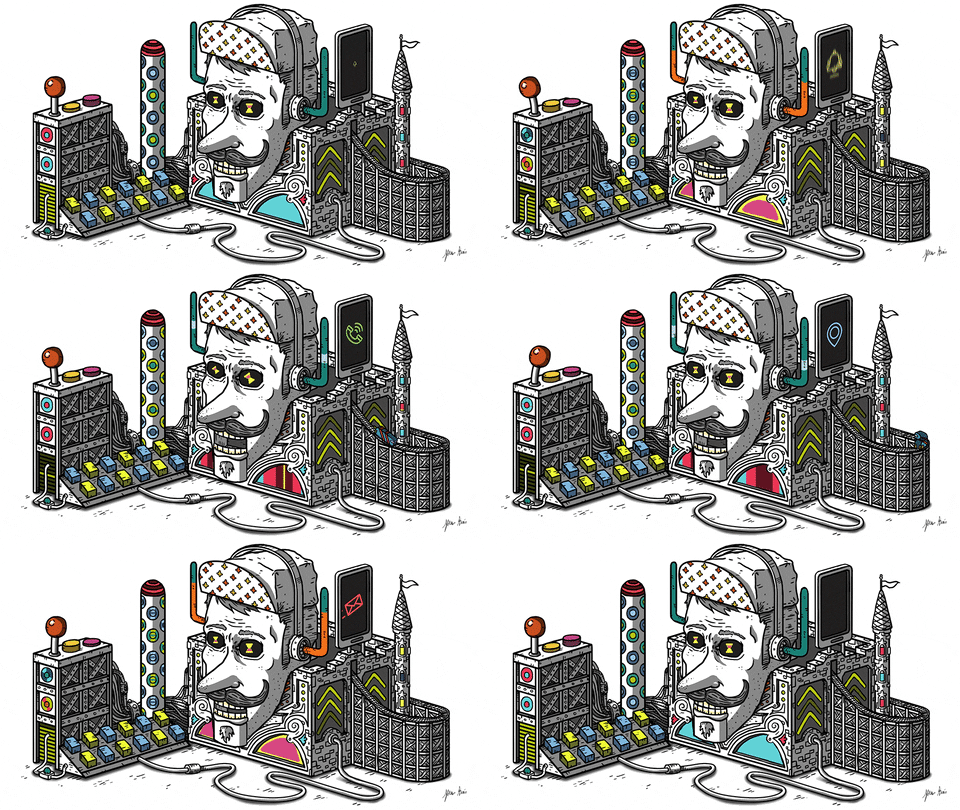

Rented Minds
There is an old Urdu phrase, khud se baat karna, that loosely translates as “talking to oneself.” It was never about soliloquy. It described the act of sitting with your own mind long enough to hear what it actually thinks. For centuries, the examined life was the only life worth archiving. Diaries, letters, arguments in the college canteen, debates over chai that ran past midnight: these were the forge in which original thought was hammered into shape. The process was laborious, imperfect, and sometimes embarrassing. It was also irreplaceable.
We have, as a civilisation, decided to replace it.
To understand what we are losing, you first have to understand what was built, and how each successive technological wave quietly chipped at its foundation.
When the internet arrived in Indian homes in the late 1990s, it came wrapped in the intoxication of access. For the first time, a student in Patna could read the same journal as a student at Oxford. A shopkeeper in Surat could pull currency rates in real time. Information, which had always been an asset hoarded by proximity to cities, libraries, and universities, became suddenly and staggeringly democratic. India had a particular hunger for it, a hunger born of decades of scarcity both material and intellectual. The internet fed that hunger without asking questions.
What it also did, more subtly, was begin to shift the burden of thought from the individual to the network. Why formulate an opinion when you could simply receive one? Why write a letter when a forward could say it better? The first great wave of outsourcing in India was not of jobs to multinationals. It was of intellectual effort dressed up as connectivity, and nobody filed a petition against it.
Social media arrived next, and it was a different beast entirely. Where the early internet was largely a library, passive and encyclopaedic, platforms like Facebook, Twitter, and later Instagram and WhatsApp were arenas. Expression became performance. And performance, almost by design, demands conformity. The algorithm, that cold and invisible traffic warden of attention, learned quickly that outrage travels further than nuance, that borrowed certainty outperforms tentative honesty, that the hot take is algorithmically superior to the considered position. A 2021 study published in the Proceedings of the National Academy of Sciences confirmed what most people with a functioning cortex had already suspected: Facebook’s architecture creates demonstrable echo chambers in which information propagates within ideological clusters and rarely crosses the divide. In India, the effects were amplified by sheer scale. WhatsApp alone had more than 500 million users in the country by 2023, making it arguably the most consequential epistemic infrastructure in the world’s most populous nation. It is an infrastructure that rewards virality over veracity and repetition over reflection.
The tragedy of social media was not that it gave bad ideas a platform. It was that it convinced good people that having an opinion was the same as having a thought. Scrolling became a substitute for reading. Sharing became a substitute for arguing. The hard and slow work of forming a view from first principles was replaced by the effortless consumption of someone else’s conclusion. By the time the 2020s arrived, India had created a generation of extraordinarily opinionated people who had never really had to think.
Then came the machines.
ChatGPT was released to the public in November 2022. Within five days, it had a million users. Within two months, it had a 100 million, the fastest consumer technology adoption in recorded history, outpacing even Instagram, which had taken two and a half years to reach the same milestone. The generative AI market, valued at 44 billion dollars in 2023, was already projected to exceed 66 billion dollars by 2024. These are not statistics about a product category. They are statistics about a civilisational pivot.
India, never one to arrive fashionably late to a technological revolution, went all in. As of early 2026, the country has crossed 100 million weekly active ChatGPT users, making it OpenAI’s second-largest market, trailing only the United States, a country with a fifth of India’s population. More revealing than the raw number is the demographic breakdown. Users between 18 and 24 account for nearly 50% of all messages sent from India. Broaden the window to include everyone under 30, and you are looking at 80% of all usage. India has, as OpenAI’s own chief executive Sam Altman confirmed at the India AI Impact Summit in February 2026, the largest student user base for ChatGPT anywhere on earth.
Let that sit for a moment. The country producing more than 1.5 million engineering graduates annually, the country whose competitive examinations are legendary in their brutality, the country that built an entire global services industry on the promise of intellectual capital, is outsourcing its thinking at a rate no other nation can match. And it is doing so with the blithe confidence of someone who does not yet realise they are outsourcing themselves.
The scale of what is being outsourced deserves specificity. OpenAI’s data shows that 20% of messages from Indian users request writing assistance, and a further 35% relate to work tasks. These are not idle searches. They are acts of delegation. A cover letter that once required two hours of honest self-reflection takes three minutes. A report that would have demanded a person synthesise their own understanding of a problem is assembled from machine-generated paragraphs. A LinkedIn post that should carry the fingerprints of a particular mind, shaped by specific experiences and arrived at through genuine conviction, reads instead like content produced in a vacuum, because it was.
For most of modern history, plagiarism was considered a cardinal intellectual sin. It was understood as a violation: of authorship, of originality, of the implicit contract between a writer and their reader. That contract held that the words on the page were, in some meaningful sense, the product of the writer’s own labour of mind. The reader trusted the transaction. The writer owed the reader that trust.
Generative AI has not changed the contract. It has made it unenforceable, and in doing so, has begun to make it feel irrelevant.
Consider the mechanics. A 2024 survey of 3,017 high school and college students found that nearly one in three admitted to using ChatGPT for academic assignments. A separate American study found that 82% of undergraduates confessed to some form of academic misconduct, with AI generation emerging as the single most prevalent category. But the most instructive figure is this: when researchers took an article from Investopedia, fed it into ChatGPT for paraphrasing, and ran the output through both Turnitin and AI-detection tools like GPTZero, the result was assessed as 100% original. The plagiarism had been laundered into invisibility. The crime now commits itself.
Amazon, sensing the shape of things, capped self-published titles at three books per day in September 2023 after being swamped by suspected AI-generated volumes. Publishers across the world began reporting submissions that were technically flawless and spiritually inert. CNET, after deploying AI to produce financial articles in late 2022, had to issue corrections on more than half of those pieces when readers identified blatant factual errors and borrowed constructions. The brand, having mistaken efficiency for quality, paid in the currency that matters most: credibility.
What is happening beneath all the policy hand-wringing and detection tool arms races is something more fundamental. Society is in the early stages of renegotiating its relationship with the concept of originality itself. When expression can be generated on demand, the act of expression loses its tether to the interior life. When that tether is cut, something essential about what it means to communicate, to transfer not just information but perspective, not just ideas but the specific texture of a mind working through a problem, is quietly amputated.
A 2024 paper in the Journal of Academic Ethics put it plainly: LLMs are generating text that contains substantial verbatim matches with existing web content while simultaneously passing detection filters. Separate research into AI-generated research proposals found significant levels of plagiarism that cleared multiple layers of expert review. The paradox is stark. The more sophisticated the tool, the more effectively it conceals the theft it commits.
There are legitimate arguments on the other side, and they deserve a fair hearing. AI tools democratise access in ways that matter enormously in a country like India, where a first-generation college student in a semi-urban town may have ideas of genuine brilliance but lack the linguistic fluency to express them in English, the language of professional opportunity. If a machine gives that student a better cover letter or a cleaner research summary, perhaps that is the great equaliser the technology’s evangelists promise it will be.
But this argument carries a shadow, and the shadow grows longer the more you examine it.
Thought is not merely the product of raw intelligence. It is the product of friction. The struggle to find the right word, the resistance of an argument that will not quite hold together, the frustration of writing a paragraph and then deleting it because it does not say what you actually mean: these are not inefficiencies to be engineered away. They are the process by which the mind develops its own musculature. A student who has a machine do their thinking has not been helped. They have been deprived of the thing the education was supposed to provide. Not the essay. The capacity to write the essay.
Multiple researchers have now documented this atrophying with measurable data. The researcher Shidiq, examining downstream effects of ChatGPT reliance on student cognition, concluded that overreliance makes individuals “weak in thinking critically.” A global study collecting interviews from researchers across ten countries found widespread concern that ChatGPT dependency degrades writing skills and displaces the creative faculty that genuine intellectual formation requires. Creativity, defined in the research literature as the capacity to develop original ideas and solve novel problems, is precisely the cognitive output that the constant availability of a generative shortcut corrodes first.
In software engineering there is a concept called technical debt. When you take shortcuts today, you create a burden that accumulates interest until it becomes unmanageable. What India and the broader global civilisation is accumulating right now is something that might be called cognitive debt. A generation is arriving at the threshold of adult life without having developed the neural infrastructure for sustained, original, rigorous thought. The debt will come due. It always does.
The Indian context sharpens the irony to the point of real discomfort. This is a civilisation that gave the world zero, the concept of infinity, non-violent resistance as a political technology. A civilisation whose oral philosophical tradition, the guru-shishya parampara, was built on the radical premise that knowledge must be earned through rigorous exchange, not simply received and repeated. The Upanishads were not a prompt and a response. They were an extended argument between a teacher and a student who was expected to push back, to question, to arrive somewhere the teacher had not anticipated. That tradition is being quietly supplanted by a culture in which a 21-year-old in Bengaluru asks a machine to write their thesis introduction, their LinkedIn post, their professional bio, their eulogy, and their wedding speech, not because they lack the ability, but because the machine is faster and the work has come to feel optional.
Civilisations are not static. They absorb shocks, adapt, and reorient. The printing press was accused of making people lazy readers. Television was condemned for destroying family conversation. The internet was predicted to end privacy and possibly democracy. All of these predictions contained truth. None of them contained the whole truth. The future tends to be stranger and less catastrophic than its critics fear, and stranger and more damaging than its advocates promise.
AI will be no different. The question is not whether generative technology will reshape how humanity thinks and expresses itself. It manifestly will, and the restructuring is already underway. The question is whether we will navigate that reshaping consciously or by default. Whether the renegotiation of originality will be conducted with some understanding of what is being traded away, or whether civilisation will simply slide into a world where expression is a utility: cheap, instant, disposable, and entirely severed from the interior life it once represented.
For India specifically, the stakes are higher than the data alone can capture. A country of 1.4 billion people, with a median age of 28 and a historical genius for absorbing foreign tools without losing its own centre of gravity, has an unusual opportunity. The same demographic that is currently driving 80% of ChatGPT’s Indian usage could, if properly guided, become fluent in AI as an instrument rather than a substitute. The way an architect uses design software not as a replacement for spatial imagination but as the medium through which spatial imagination operates at scale. The way a surgeon uses imaging technology not as a substitute for diagnosis but as a sharper lens through which the diagnostic mind works.
But that outcome requires something the algorithm cannot supply: a society that still knows the difference between a borrowed thought and its own. A culture that still considers the labour of thinking worth undertaking, not because it is efficient, but because it is constitutive. Because a mind that never does the hard work of forming its own opinions, wrestling with its own contradictions, and arriving at its own conclusions is not a mind that has been liberated by technology. It is a mind that has been quietly replaced by one.
Khud se baat karna. Sit with your own mind long enough to hear what it actually thinks.
That remains the only technology that cannot be outsourced.