Drowning in the Promise of a City
I did not think I would die in a city that sells itself as a promise.
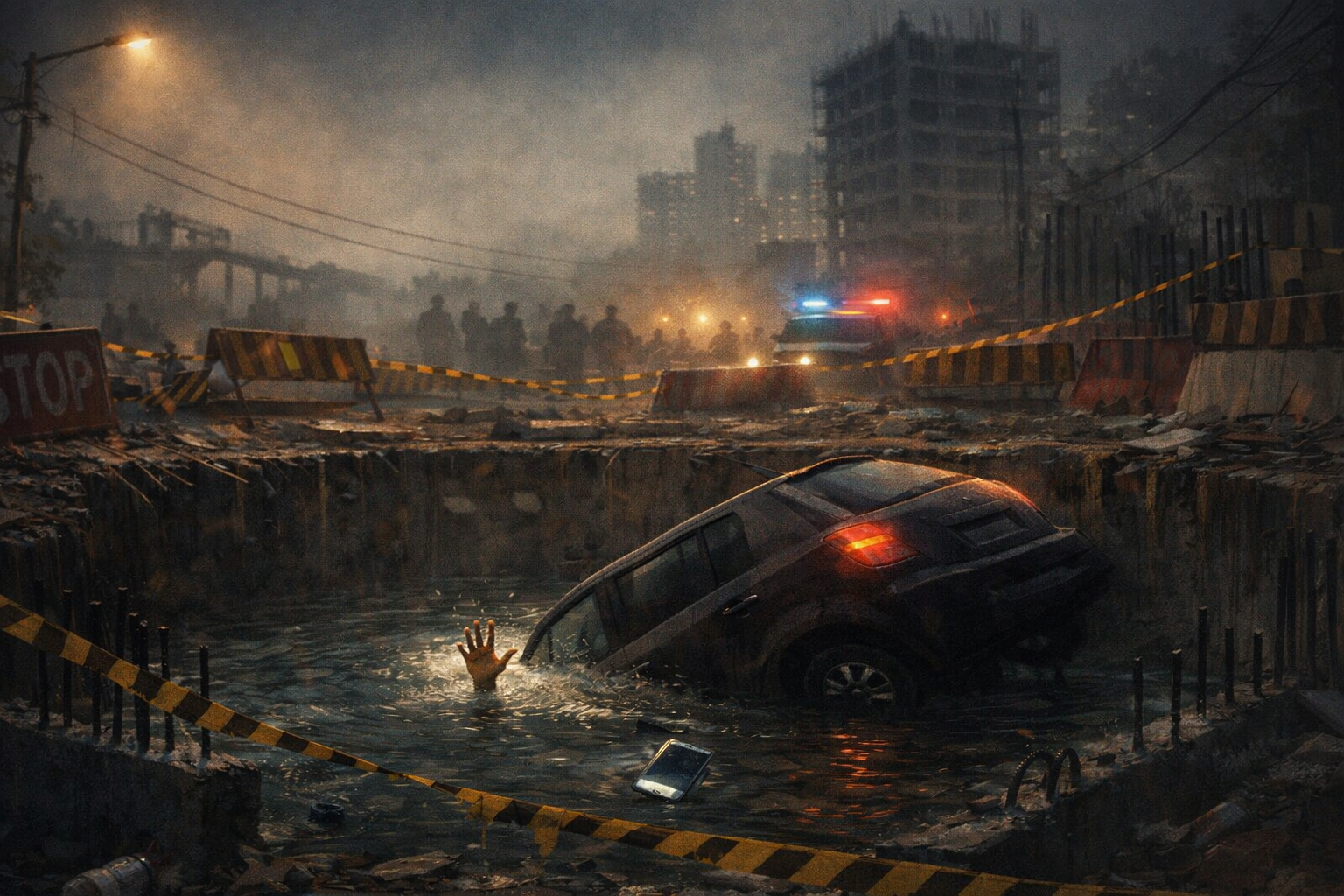
The night was ordinary in the way so many Indian nights are ordinary. Fog hanging low like a tired curtain. Headlights cutting thin tunnels through white air. The road familiar enough that my hands drove more from habit than intention. I was thinking of small things: the next meeting, the next EMI, the next weekend that would arrive and vanish, the next message I would send and forget. I was thinking, absurdly, about saving a few minutes.
Then the road ended without telling me it had ended.
A trench, a pit, an unfinished basement, a mouth that had been left open in the dark as if the city itself had decided to yawn at passing traffic. My car did what machines do. It obeyed physics. It broke its boundary. It fell. The world turned vertical, then liquid. Water rushed in with the impatience of something that has waited too long to be acknowledged. In Sector 150, Greater Noida, a young professional died the way no modern city should allow: swallowed by a water filled construction pit, in an incident that has triggered investigations and warrants and anger, the usual choreography that arrives after a life has already left.
In those first seconds, there is no philosophy. There is only the body, bargaining with oxygen. There is the taste of panic, metallic and crude. There is the sudden knowledge that all the confidence you have ever carried is not a shield, it is merely a mood you were lucky enough to afford.
I remember my phone in my hand. The instinct to call someone, anyone, because we are raised to believe that if we can reach the right person, reality will rearrange itself. I remember noise above, voices that sounded close and far at the same time. I remember the waterline climbing, as calm as a bureaucrat stamping forms.
And I remember, with a clarity that makes me angry even now, how quickly a modern life becomes primitive. One wrong turn. One missing barricade. One unlit edge. One ordinary citizen turned into an emergency.
You can build towers. You can lay tiles that shine in the sun. You can hang banners about world class living. But you cannot argue with an open pit.
The strangest part was how familiar it felt. Not personally, not to me, but to the country that raised me. We are trained in this kind of familiarity. We learn early that danger is not always a criminal with a knife. Sometimes danger is a municipal decision postponed. Sometimes danger is a contractor saving money on a railing. Sometimes danger is the quiet confidence that someone else will handle it.
In those final minutes, my mind did what minds do when they cannot change the present. It started touring the past. It pulled out my wishes like files from a cabinet, flipping them open with wet fingers.
हज़ारों ख़्वाहिशें ऐसी कि हर ख़्वाहिश पे दम निकले
बहुत निकले मेरे अरमान लेकिन फिर भी कम निकले
I had wishes. Not the dramatic kind. The soft, middle class kind. A promotion that would let me breathe. A flat that would let my parents stop worrying. A holiday that would feel like a reward rather than a budget exercise. Love that would not collapse under the weight of fatigue and deadlines. A life where small effort produced small stability.
It turns out I was drowning in a country that is also drowning, just more slowly. The nation does not go under in one night. It fills inch by inch. With excuses. With shortcuts. With indifference dressed up as practicality.
Somewhere in the noise above, I heard words that sounded like procedure. Someone making a call. Someone waiting for someone else. Someone describing the situation as if describing it could undo it. In another report, in another retelling, you will see the same pattern being interrogated, eight hours of questioning, a hundred statements, an investigation team trying to locate responsibility in a crowd because it has learned that responsibility, in India, is best hidden in groups.
I do not need villains. I am not asking for cinematic evil. I am asking for the boring competence that saves lives. The competence that ensures a pit is fenced. The competence that puts lights where darkness is predictable. The competence that treats one missing barricade as seriously as one missing kidney.
If this sounds like anger, it is. But it is also grief. Anger is what grief wears when it does not want to be dismissed.
When the water reached my chest, my mind did something else. It began to widen. It reached beyond Noida.
I thought of Indore, of Bhagirathpura, of water again, but not as a sudden pit. Water as a daily trust, delivered through pipes and taken for granted, until that trust curdles into illness. Reports from late December 2025 and early January 2026 describe residents falling sick after contaminated drinking water, with a death toll that rose as the days passed and hundreds, even over a thousand, reported ill. Indore is celebrated as a clean city, and yet cleanliness is not a trophy, it is a practice that has to hold under stress.
This is the satire of our times. We win rankings and lose neighbours. We polish the outside and neglect the inside. We announce achievements and postpone maintenance. We speak of systems and forget that systems are meant to serve bodies, not spreadsheets.
Water killed me in Noida, but water also killed in Bhagirathpura, and in the grim symmetry of it, I saw something that felt like a national signature. The same element that sustains us becomes lethal when governance becomes casual.
If you want to know what an ordinary Indian feels, look at what we accept as normal. We accept that drains can be open near homes. We accept that construction sites can bleed into public roads. We accept that the city can be a maze of hazards and the citizen must simply become more alert, more cautious, more resigned.
An 11 year old boy in Ghaziabad, playing near home, fell into an open drain and later died, in a story that reads like an indictment written in plain language. A similar pattern shows up elsewhere: a four year old in Ahmedabad killed when a manhole cover slab fell on him at a drainage project site. These are not freak accidents. They are predictable outcomes of predictable neglect.
And then there is Delhi, a city that has taught the country new definitions of the word basement. In July 2024, three civil services aspirants died when floodwater entered a coaching centre basement library in Rajendra Nagar. The image is unbearable: students who came to build a future, trapped by water that should have been managed by a city that claims to run the nation.
Sometimes, the failures are louder. A bridge collapses and vehicles plunge into a river. People die on the commute they have taken a hundred times. In July 2025, the Gambhira bridge collapse in Gujarat became another entry in the long ledger of infrastructure that is used hard, maintained lightly, and mourned publicly.
So yes, I drowned in Noida, but if you are looking for the real drowning, look at the pattern. Look at the rhythm. A hazard exists. Warnings circulate. People adapt. Tragedy happens. Committees form. Statements are recorded. Someone is suspended. A promise is made. Another hazard waits patiently for its turn.
Satire is supposed to be funny. Mine is not. Mine is the kind of satire that arrives when reality is already mocking you.
दुःख में सुमिरन सब करैं सुख में करै न कोय
जो सुख में सुमिरन करै तो दुःख काहे को होय
Kabir was not talking about municipal drains, but he might as well have been. We remember values in crisis and forget them in comfort. We demand accountability after death and tolerate negligence during life. We seek God when the water rises, but in the dry hours we do not seek the discipline that prevents the flood.
I can hear someone objecting now. This is India, things are complicated, population is high, resources are limited. True. The world is complicated. India is huge. But complexity is not a licence for carelessness. Limited resources are precisely why the basics must be non negotiable. A barricade is not a luxury item. A covered drain is not a premium feature. Safe public design is not a favour, it is the minimum contract between a citizen and the state.
And here is where I must turn the mirror slightly, because satire without self scrutiny becomes mere shouting.
We, the ordinary Indians, also participate in this drowning. Sometimes by bribing the inspector to look away. Sometimes by parking on the footpath and forcing pedestrians onto the road. Sometimes by treating civic rules as suggestions for other people. Sometimes by normalising the phrase chalta hai, which sounds harmless until you realise it is the national lullaby we sing to danger.
I am not asking for sainthood. I am asking for citizenship, which is a far more practical job.
So what must an ordinary Indian do, when the world looks like this, when water kills in pits, in drains, in pipes, in basements?
First, refuse to treat preventable death as fate. Language matters because it sets the ceiling of our expectations. When we call negligence an accident, we shrink the space in which accountability can live. When we say it was destiny, we absolve everyone who made a choice that led to that moment.
Second, learn the local levers. India is noisy at the centre, but many of the things that kill us are local. Ward offices. Municipal complaint portals. Resident welfare associations. Local councillors. Local engineers. If the streetlight is out, complain in writing, not only in conversation. If a pit is open, photograph it and report it. If the complaint is ignored, escalate it. This is not activism for its own sake. This is basic risk management for your neighbourhood.
Third, support the unglamorous people who keep the system honest. Local reporters. RTI users. Lawyers who file public interest litigation. Citizens who attend municipal hearings even when it is boring. These are the immune cells of a democracy. When they are weak, infections spread quietly until the fever becomes a headline.
Fourth, vote like you live here. National politics is theatre. Municipal politics is plumbing. We spend emotional energy on the stage and neglect the pipes. Yet it is the pipes that poison a locality, the drains that swallow children, the roads that send cars into trenches. Ask candidates about maintenance schedules, audits, contractor accountability, emergency response times. If they cannot answer, that is your answer.
Fifth, rebuild the social contract at human scale. Stop thinking of fellow citizens as obstacles. The person walking slowly is not your enemy. The cyclist is not your inconvenience. The pedestrian has the same right to safety as the driver. Civil behaviour is not moral decoration. It is a safety system.
This is where poetry returns, because policy gives you structure, but poetry gives you nerve.
रहिमन धागा प्रेम का, मत तोड़ो छिटकाय
टूटे से फिर न मिले, मिले गाँठ परिजाय
Rahim is speaking of love, but the lesson fits the bond between people and institutions. A social contract is a thread. You can stretch it, you can neglect it, you can jerk it for short term gain. One day it snaps. You can tie it back, but the knot remains, a permanent lump of distrust.
India today is full of knots. Citizens distrust contractors. Residents distrust officials. Officials distrust citizens. Everyone distrusts the idea that the system can work without personal influence. We do not lack intelligence. We lack faith in boring process. We have replaced systems with jugaad, and then we act surprised when the system behaves like a pile of improvisations.
And still, despite everything, I do not want to end where many essays end, with despair dressed as realism. Despair is lazy. It asks nothing of you except resignation.
In my last moments, I was not thinking about national decline or global commentary. I was thinking, very simply, that I wanted to live. That desire is not philosophical. It is the most ordinary thing in the world. It is what every child expects the city to protect without having to ask.
So let me leave you with one more couplet, not as romance, but as instruction.
राह-ए-दूर-ए-इश्क़ में रोता है क्या
आगे आगे देखिए होता है क्या
Mir is telling you that the journey is long and the sorrows do not end at the first bend. But there is another way to read it. Do not stop at the first shock. Look ahead. See the pattern. Then decide that you will not be a silent participant in it.
The world will continue to be messy. Climate will make water more unpredictable. Cities will continue to expand. Construction will continue. Mistakes will happen. But negligence does not have to be our default setting. A country this capable does not need to die of small incompetences.
I died because a pit was left open, and because the night did what nights do, it hid it.
If you are alive, you still have the unfair advantage I no longer have. You can insist on light. You can insist on barriers. You can insist that safety is not a privilege for the wealthy, but a right for the ordinary.
Do it without drama. Do it without cynicism. Do it with the patient stubbornness that makes systems change.
And when you pass a dark stretch of road tonight, slow down. Not only because you fear a pit, but because you remember that somewhere in this country, someone has already paid the price for the city’s unfinished work.