My Lord, Please Pass the Bug Spray,” Whispered the Cockroach”!
There is a particular cruelty in being called a cockroach by the one man whose office exists to defend your dignity. On the fifteenth of May, in open court, the Chief Justice of India likened the country’s unemployed young to cockroaches and to parasites feeding on the body of society. He meant, he explained afterwards, only the frauds who buy their way into the professions with counterfeit degrees. The correction was sound. It was also useless, for the wound had already found the people it was never aimed at, and they recognised themselves in it at once.
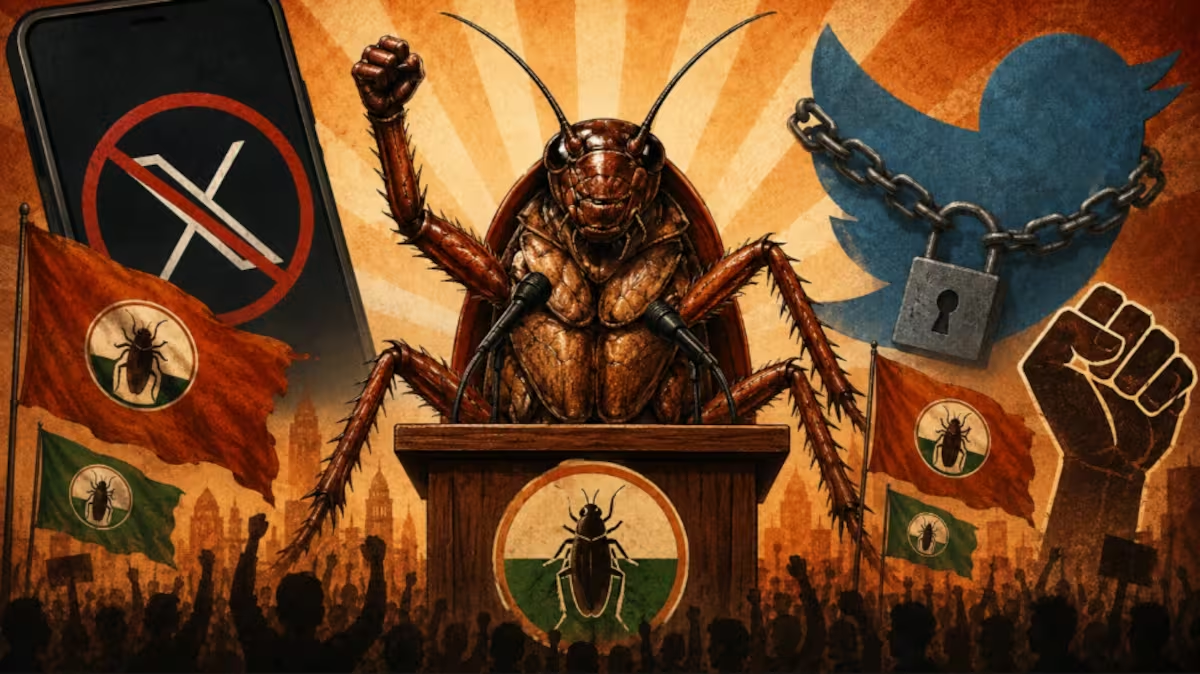
A day later a thirty-year-old public relations graduate named Abhijeet Dipke, caught between Boston and home, did the only thing a humiliated generation reared on the internet knows how to do. He turned the insult into a flag. The Cockroach Janta Party arrived as a parody of the ruling Bharatiya Janata Party, its name a small grammatical joke, since janta means the people, its emblem a cartoon roach in a politician’s sash. It asked for nothing and promised less. Within a week it had gathered more than twenty million followers, a congregation larger than the one the ruling party has assembled across four decades of toil. The State, which had managed to ignore the unemployment, did not manage to ignore the roach. By Thursday the party’s account on X had been pulled down on the advice of the Intelligence Bureau, which had concluded that a comic insect threatened the sovereignty of a republic of a billion and a half souls. Nothing the movement said about the government was half so eloquent as that.
To understand why a joke caught like dry grass, you have to leave the courtroom and walk into the kitchen, because that is where this anger is cooked. The cooking-gas cylinder, the humble red drum on which the Indian meal depends, now sits at or above a thousand rupees, and commercial gas has been pushed up again and again through the early months of 2026, every increase travelling down the chain to the tea stall and the roadside kitchen until it lands on the plate. A fresh rise in petrol and diesel has hovered over the household all spring, held back by a caution that everyone can see through. The family that once stretched a single cylinder across a month now rations it, and some have drifted back to wood and kerosene, trading their lungs for their budget. The squeeze is not a statistic. It is the smell of a kitchen burning cheaper fuel.
And then that same family, scrolling by the light of the phone at night, watches the cavalcade. It watches the file of identical white cars part the traffic for a minister, the foreign holiday photographed against an alpine backdrop, the airport lounge, the wardrobe worth a clerk’s wage for a year. The dissonance is total. A leadership that lectures the young on the dignity of labour and the virtue of patience seems to practise neither, and the young have noticed. This is the soil in which the Cockroach Janta Party put down its shallow, rapid roots. It carries no programme worth the name. Its whole force comes from naming, without apology, the gulf between what the powerful preach and how the powerful live.
The joblessness has an architecture, and it repays a closer look than the headline rate allows. From the age of fifteen the ambitious child is fed into a machine, despatched to a coaching town to be drilled for an entrance examination that a handful in a hundred will clear, his adolescence and his parents’ savings poured into a single roll of the dice. Those who fail the dice, and most must fail it, are caught by an economy that has learned to dress its dead ends in flattering language. The graduate who cannot find a salaried post becomes a delivery rider and is told he is an entrepreneur, paid by the parcel, insured against nothing, his degree folded into the glovebox of a borrowed motorcycle. A society can absorb a great deal of this quietly, for shame is a private muscle and it tires slowly. What it cannot absorb is the discovery, made simultaneously by millions, that the shame was never theirs to carry.
A sociologist would call the underlying condition anomie, the vertigo that grips a society when its promises and its possibilities come unstuck. India has spent a generation selling its children one story. Study, and you will rise. The degree was the ladder and the examination the gate, and merit, they were told, was the only currency a fair republic recognised. The young believed it, and they studied, and a great many of them climbed to the top of the ladder to find no roof there. A study from Azim Premji University this spring found that close to two in five graduates under twenty-five are without work, a rate far worse than among their less educated peers, which turns the moral of the story inside out. The diploma was meant to be the escape. For millions it has become an expensive certificate of redundancy.
The injury is sharpened by the suspicion that the gate itself is rigged. When the NEET medical entrance paper leaked in 2024, it did not merely spoil one examination; it confirmed a fear that had been forming for years, that the meritocracy was a stage set, and that behind it the old machinery of money and connection ran on as it always had. Relative deprivation, as the sociologists understand it, bites hardest not at those who have always had nothing but at those who were promised something and watched it withdrawn at the threshold. That is the exact emotional address of the Indian graduate in 2026. He is not starving. He is humiliated, which in a proud and aspirational country is by far the more combustible state.
What has changed is the room in which this generation gathers to feel it together. The street was the classical theatre of Indian protest, and the street can be policed, dispersed, baton-charged, photographed for the file. The feed could not be, or could not until the State began trying. The meme has become this generation’s rite of communion, its means of discovering, all at once and in their millions, that the private shame of joblessness is in truth a public condition with a public cause. There is a bitter circularity in the iconography, for the party’s grinning cockroach-man is itself machine-made, conjured by the same artificial intelligence that the same young people are warned will swallow the few jobs that remain to them. They have made a mascot of their own obsolescence. A cockroach in a sash is a feeble argument and a magnificent sacrament. It tells a frightened young person alone in the dark that twenty million others are in the dark beside him, laughing the same bitter laugh.
Here the movement becomes a mirror, and the reflection is unkind. A nation, like a person, can hold two incompatible images of itself at once, and the strain of holding them shows in strange places. Official India has spent a decade narrating its own arrival. It calls itself the Vishwaguru, the teacher of the world, and the fastest-growing major economy on earth. Private India, in the meantime, queues for a government clerkship that twenty thousand graduates will sit and forty will win. The distance between the anthem and the experience is the country’s open psychological wound, and the Cockroach Janta Party pressed a thumb directly into it.
There is a deeper psychology still in the choice of the symbol. To be called vermin is to be told that you are surplus, that the republic would rather you were gone, that you persist in its kitchen against its wishes. A timid people would have flinched from the word. This generation picked it up and wore it, performing the oldest manoeuvre in the history of the despised, the turning of a slur into a name worn with pride. The cockroach, after all, is the supreme survivor, the creature that endures the poison and outlasts the empire and is found in the ruins long after the householders have fled. In adopting it the young were saying something the State grasped well enough to fear. You called us pests. Very well. We are the ones who cannot be exterminated.
It is worth pausing on that word, for it has a darker history than its comedy admits, and the wiser commentators have said so. The editors who first cheered the movement also remembered that inyenzi, the word for cockroach, was the very instrument by which Rwanda rehearsed its slaughter of 1994, the long preparation of the mind that lets one set of human beings be spoken of as an infestation to be cleared. No one imagines the Chief Justice intended anything of the kind, and the comparison should be made with care rather than relish. But a vocabulary of vermin, even when reclaimed in jest by its targets, is a flammable thing to loose into a polity already drawn along its fault lines, and a country would be foolish to grow comfortable hearing its own citizens described that way from the bench.
None of this is the first time the Indian young have turned upon their elders, and the establishment forgets the lineage at its peril. In 1974 it was the students who marched behind Jayaprakash Narayan against corruption and misrule, and the answer they received was the suspension of the Constitution itself. In 2011 a movement against graft filled the maidans of the capital and bequeathed the country a new party, the Aam Aadmi Party, born of that very anger, and it was for that party that Abhijeet Dipke worked before he left for Boston. The roach, in other words, has a pedigree. When the government’s defenders point to Dipke’s old allegiance and cry conspiracy, calling the whole affair a front got up by the opposition, they are not wholly wrong about the connective tissue, and they are entirely wrong about what it means. Every such movement in the country’s history has been dismissed as a put-up job by interested parties, right up to the morning it stopped being possible to dismiss it. The charge of conspiracy is the sound an establishment makes when it has run out of better answers.
There is a reason that power fears the joke more than the manifesto, and the Cockroach Janta Party has supplied a demonstration of it. A regime knows how to answer a fist with a fist and a slogan with a louder slogan, for those are confrontations it understands and can win on its own terms. It has never found a reply to laughter that does not make it more ridiculous. The censor who bans a cartoon becomes the cartoon. By blocking the account and invoking the sovereignty of the nation against a drawing of an insect, the State did not silence the satire; it authored its finest punchline, and twenty million people shared it before the week was out. The breadth of who shared it should trouble the strategists, for the followers were not only the unemployed. Opposition members of Parliament asked publicly how to enrol, a former cricketer turned politician offered his services, and a parade of the country’s most admired film-makers, comedians and actors lent the joke their names, which is how a private grievance acquires the dignity of a public cause.
Legitimacy is the quiet currency of all government, and it is not minted only at the ballot box. It is renewed, or spent, in the daily congruence between what the powerful preach and how they live. A leader who asks for sacrifice and is seen to share in it commands; a leader who asks for sacrifice from the back of a convoy commands only so long as the convoy holds. When that congruence breaks, authority does not collapse so much as hollow out, keeping its shape while losing its weight, and into the hollow rushes whatever can name the hypocrisy most sharply. In the India of 2026 the sharpest naming happened to be a joke about an insect.
This is the true source of the Cockroach Janta Party’s standing, and it explains the paradox that has so unsettled the establishment, that a fictional party with no candidates is trusted further than the real ones with their crores and their cadres. The young have not mistaken the roach for a government in waiting. They know perfectly well that it can neither pave a road nor pass a law. What they register, in following it by the million, is a withdrawal of consent from a class they believe has forfeited its right to lecture them.
The movement’s modest manifesto, with its demand to end the plush retirement postings dangled before compliant judges, to throw open half of Parliament to women, to guarantee the vote and a free press, and to halt the buying and selling of legislators between parties, reads less as a programme than as a charge sheet. Each clause marks a spot where the preaching and the practice have quietly parted ways.
India’s rulers would be unwise to read this as a purely domestic squall, for the same wind has been crossing the whole of South Asia, and it has flattened sturdier structures than a meme. Sri Lanka went first, in 2022, when an empty treasury drove ordinary people into the president’s swimming pool and ended a dynasty. Bangladesh followed in 2024, when a quarrel over job quotas swelled into the revolt that drove Sheikh Hasina across the border into India, and the students who led it have since turned their fury into a party of their own, the National Citizen Party, and walked it to the polls. Then came Nepal last September, where a clumsy ban on social media lit a fire that consumed the parliament building itself, cost more than seventy lives, and ended with the prime minister gone and a former chief justice installed to hold the ruins together. Indonesia ran the same fever the same year. Nor has the contagion stopped at the edges of Asia, having broken out in Morocco and Madagascar, in Peru and Bulgaria, wherever a young majority has found itself ruled by an order it no longer believes. The young of these places now learn from one another in real time, across borders that mean nothing to a phone, and the lesson they have absorbed is plain enough. A government that gropes for the off-switch on speech has already begun to lose.
The more sobering lesson is the one that the analysts at Carnegie and the Council on Foreign Relations keep pressing, and it cuts hard against the romance of the barricade. Toppling a government is the easy miracle. Building one is the long and unglamorous labour at which youth movements have so far mostly failed. Every Nepali generation has overthrown a regime, yet none has converted the overthrow into a settled and better order, and the elections that Dhaka and Kathmandu have lately held will test whether this turn of the wheel does any better. The energy of the feed scatters as fast as it gathers, and the old machinery, patient and well financed, tends to outlive the carnival. India is not Nepal. Its institutions run deeper, its army keeps out of politics, its electoral apparatus is vast beyond comparison. But the kindling that lit those other fires is stacked here in quantity, and the match is the same shape in every hand.
So what, in the end, is the country being told. Not that a government is about to fall, because it is not. The Cockroach Janta Party will field no candidate and storm no parliament, and within a year its founder may be a footnote. What it has proven is more durable than any tally of seats. It has shown that the formal institutions of Indian politics no longer command a monopoly on the loyalty of the young, and that a great mass of them will rally to a symbol of contempt faster than to anything offered on the ballot. That is a structural fact about the republic, and it will not be restored along with a blocked account.
The variables that would carry this from symptom to rupture are not obscure. The first is the kitchen, for if the cost of living keeps climbing while wages stand still, the abstract grievance acquires a daily and physical edge, and physical edges cut. The second is the conduct of the State itself, since every act of suppression launders the movement’s legitimacy and lends it the dignity of the censored. The third is leadership, because a diffuse mood becomes a force only once someone gives it an address and a date. The fourth is the regional weather, for should the post-uprising elections now under way deliver anything resembling reform, the demonstration effect on a watching Indian youth will be considerable. Hold those four steady and the roach stays a joke. Let two or three of them slip and it becomes a chapter.
For the wider world, the moral is the one that governments keep declining to learn. A generation has come of age that treats the network as its parliament and the joke as its weapon, and it is recognisably the same generation in Kathmandu and Dhaka and Colombo and now Delhi. You cannot govern it by cutting its microphones, because the silence you manufacture is itself the most damning thing you could have said. India has been handed an unusually clear warning, and it arrived, with a fitting irony, dressed as the one creature that survives whatever is thrown at it. The intelligent response is to read the message. The reflex, so far, has been to reach for the slipper.